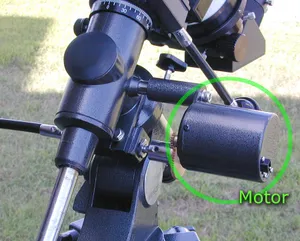
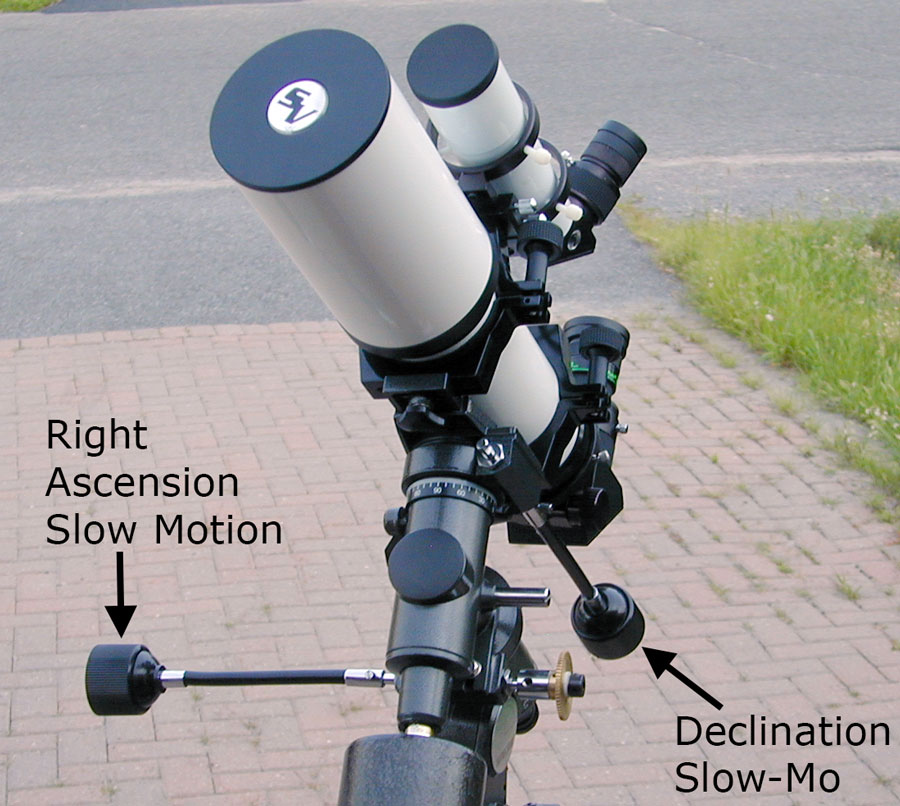
If you draw an imaginary line through the mount at a right angle to the counterweight shaft, you define the polar axis. This part of the mount will be aligned to point to the North Celestial Pole (NCP), and it does not move, even when the telescope is moving in the other directions in which it can.
What seems like extra complexity in EQ mounts will become simpler if you remember that the whole point of an EQ mount is to get, and keep, this axis pointing toward the NCP. We’ll discuss how to do this in a later article.


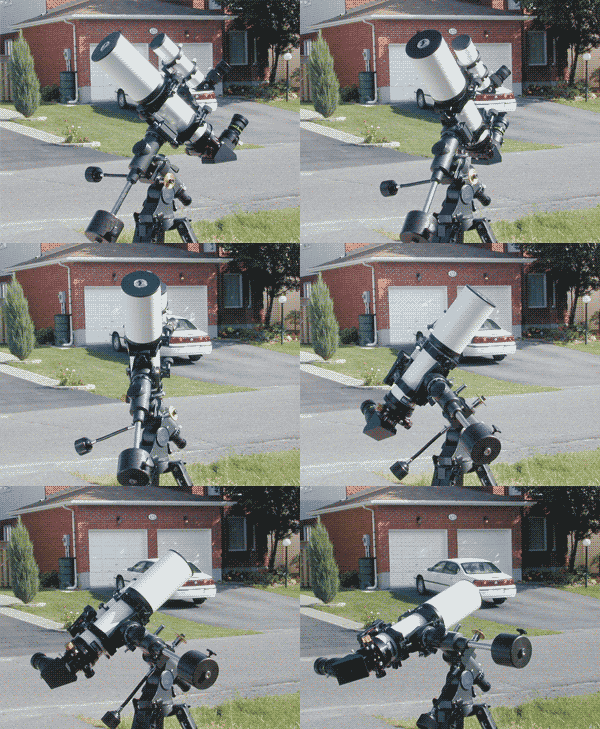
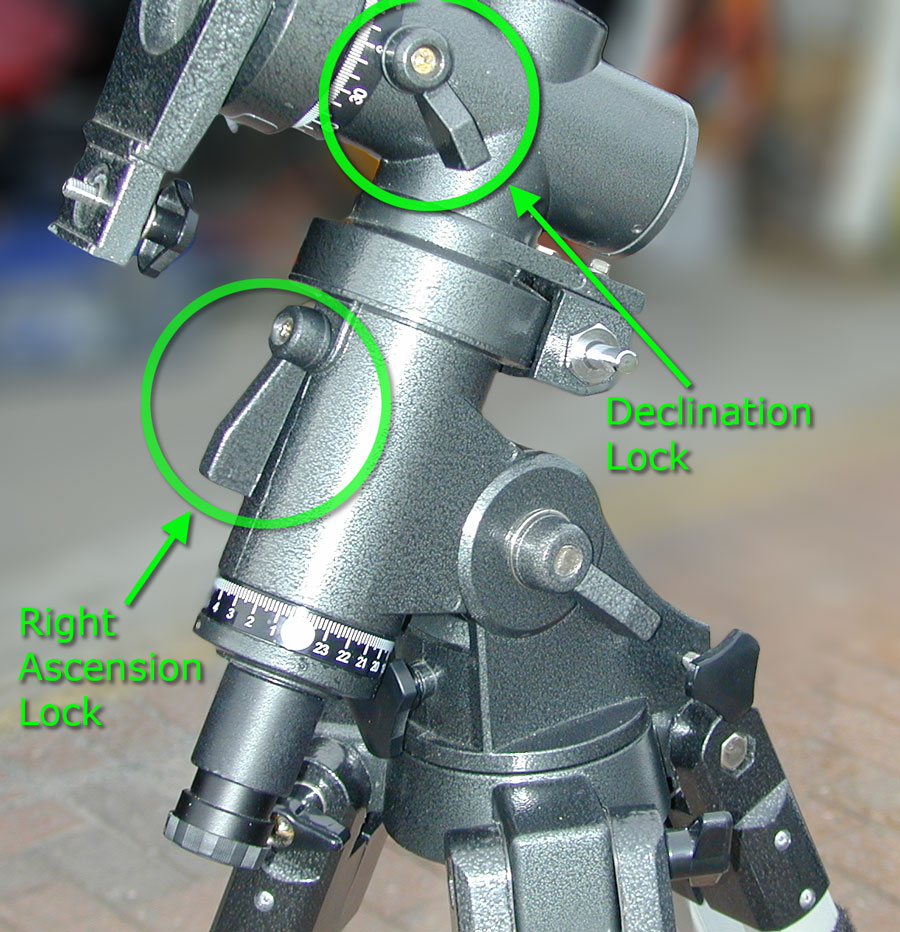
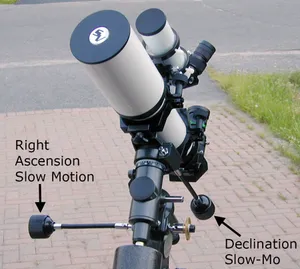
Next, it can rotate around the direction defined by the counterweight shaft. This motion is called Declination.
Summary: Move the telescope; if the counterweight is moving, that is Right Ascension. If the counterweight is not moving, that is Declination.


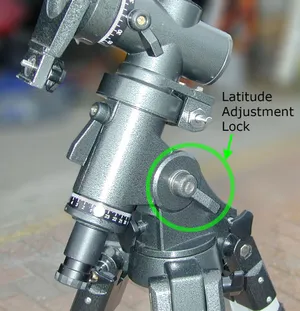
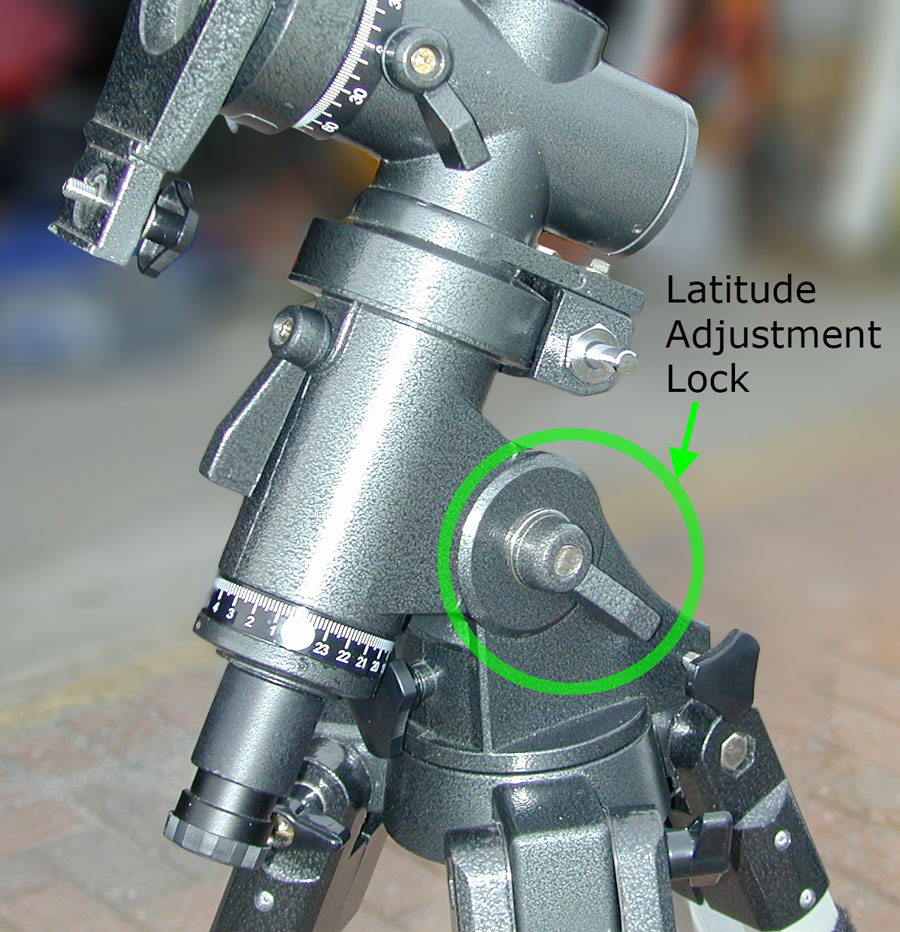
There is usually also a scale somewhere showing the current elevation of the polar axis in degrees. The elevation is usually set to your latitude on Earth (or close to that, adjusting for lack of levelness in the mount), so this is generally called the “Latitude Scale”. We’ll discuss this when we discuss polar alignment.
Again, these controls are not used to point the telescope, they are used to align the mount. You’ll use them infrequently – typically only when you set up your mount the first time, or if you disassemble it or move.