Periodic Error is a small mechanical error in the accuracy of the tracking in a motorized mount resulting in small movements of the target that can spoil long-exposure images, even if the mount is perfectly polar-aligned and appears to be tracking perfectly in short tests. It is called periodic because it repeats at a regular interval — the interval being the amount of time it takes the mount’s drive gear to complete one revolution. Most motorized mounts suitable for astrophotography use moderate-speed motors and a gearing system to produce the very smooth, slow-speed rotation of the Right Ascension axis needed to track target objects.
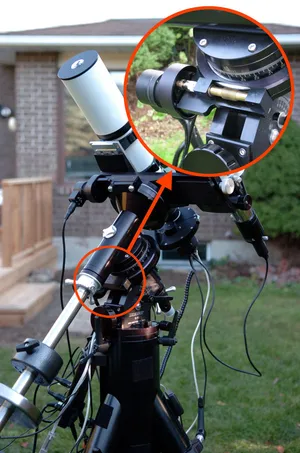
On most such mounts, the drive motor turns a worm gear which, in turn, drives a large disk gear attached to the Right Ascension axis. These gears are machined to a very high precision. However, no machining is perfect, and the manufacturing is also constrained by the overall price target for the class of mount. So, minor imperfections will always remain in the gears.

Imagine, for example, if the teeth on the worm gear were displaced slightly to one side at one point on the gear. When that point on the worm rotated through the RA gear, the RA would be pushed either too far ahead, or too far behind, depending on the direction of the error. The error might self-correct if the next portion of the worm gear is distorted in the other direction, or it might accumulate.The error would repeat the next time, and every time, that flawed bit of worm gear rotated around to contact the RA gear. This error that repeats with each revolution of the worm gear is Periodic Error.
This simulation is exaggerated — typically the error would cycle over a period of several minutes.
(This animation is an “animated gif” graphic. If you are not seeing moving pictures, make sure that your browser settings have not disabled animated gif graphics. Better still, click on the image to view it stand-alone in a separate window.)

Periodic Error is small back-and-forth oscillations of the target stars, along the East-West line. The small motion is often not noticeable during visual observation, but during a long exposure it will change stars from pinpoints to small streaks.If your stars are small streaks and the streaks a perfectly aligned east-west, you probably have periodic error.
(If the streaks are aligned in some other direction, or are curved, you probably have inadequate polar alignment.)


